The Breakout Game
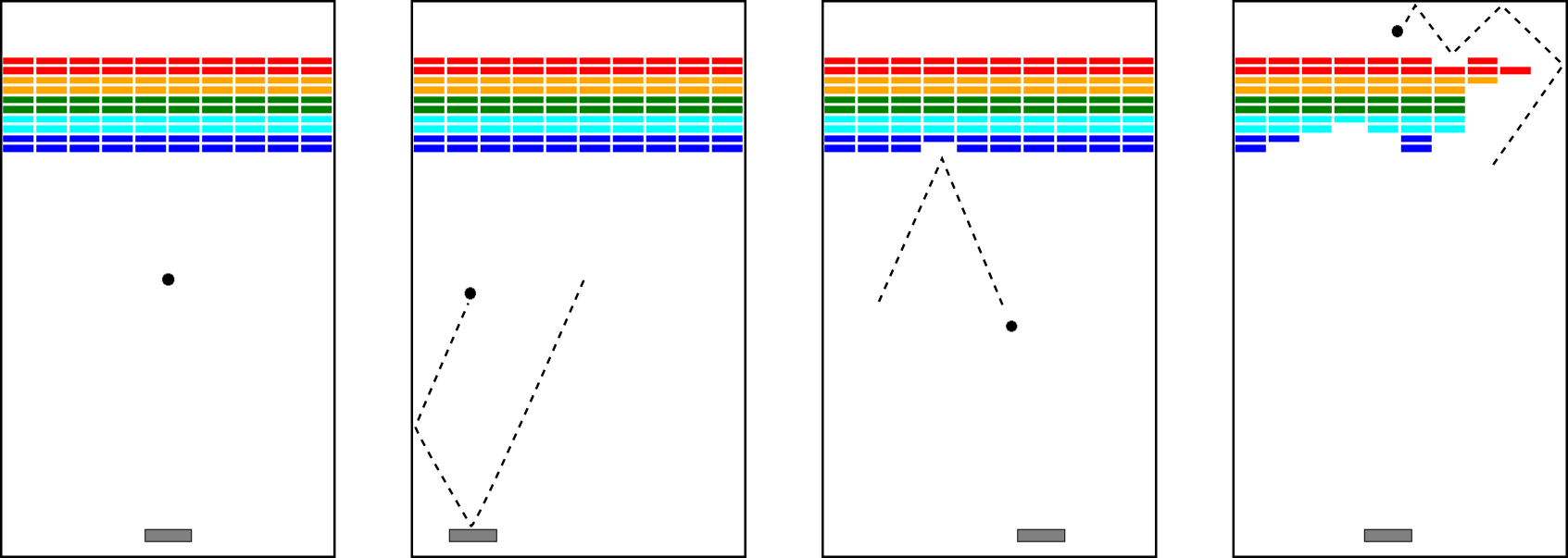
In Breakout, the initial configuration of the world appears in the leftmost image of Figure 1. The colored rectangles in the top part of the screen are bricks, and the slightly larger rectangle at the bottom is the paddle. The paddle is in a fixed position in the vertical direction, but moves back and forth across the screen along with the mouse until it reaches the edges of the window.
A complete game consists of three turns. On each turn, a ball is launched from the center of the window toward the bottom of the screen at a random angle. That ball bounces off the paddle and the walls of the world, in accordance with the physical principle generally expressed as “the angle of incidence equals the angle of reflection” (which turns out to be very easy to implement as later discussed). Thus, after two bounces–one off the paddle and one off the left wall–the ball might have the trajectory shown in the second image in Figure 1. (Note that the dotted line is only there to show the ball’s path and does not actually appear on the screen.)
As you can see in the second image, the ball is soon to collide with one of the bricks on the bottom row. When that happens, the ball bounces just at it does on any other collision, but the brick disappears. The third image shows what the game looks like after that collision and after the player has moved the paddle to put it in line with the oncoming ball.
The play on a turn continues in this way until one of two conditions occurs:
- The ball hits the lower wall, which means that the player must have missed it with the paddle. In this case, the turn ends and the next ball is served if the player has any turns left. If not, the game ends in a loss for the player.
- The last brick is eliminated. In this case, the player wins, and the game ends immediately.
After all the bricks in a particular column have been cleared, a path will open to the top wall. When this delightful situation occurs, the ball will often bounce back and forth several times between the top wall and the upper line of bricks, without the user ever having to worry about hitting the ball with the paddle. This condition is a reward for “breaking out” and gives meaning to the name of the game. The rightmost image in Figure 1 shows the situation shortly after the ball has broken through the wall. That ball will go on to clear several more bricks before it comes back down the open channel.
It is important to note that, even though breaking out is a very exciting part of the player’s experience, you don’t have to do anything special in your program to make it happen. The game is simply operating by the same rules it always applies: bouncing off walls, clearing bricks, and otherwise obeying the laws of physics.